
Advancing Naval ISR with Autonomous Sensor Operations

Overwatch Imaging ASO Software delivers force-multiplying autonomy to wide-area maritime ISR missions

As unmanned and distributed surveillance platforms continue to expand collection capacity, the challenge of collecting, analyzing and exploiting large volumes of video data becomes more acute. ASO removes this bottleneck by enabling platforms to autonomously search, detect, prioritize, and report actionable information at the edge, supporting faster decisions and more effective use of ISR assets at scale.
Modern naval operations demand faster decisions, broader situational awareness, and the ability to operate effectively in bandwidth-constrained environments. Yet today’s ISR workflows remain heavily dependent on manual sensor operation and data analysis.
Overwatch Imaging is advancing a new approach. Automated Sensor Operations (ASO) is a software-defined capability that transforms full-motion video (FMV) systems into autonomous, real-time intelligence assets.
From Manual Monitoring to Autonomous ISR
Naval vessels and aircraft generate vast volumes of full-motion video across maritime areas, but traditional workflows rely on human operators to collect the data and monitor the the feeds, limiting coverage due to operator limitations, fatigue and resource constraints.
ASO autonomously directs sensors to scan areas of interest and applies AI models, trained on extensive real-world maritime imagery, to detect and classify objects within the search area. By combining automated sensor control with onboard analytics, the system maintains persistent awareness without requiring constant human oversight.
Intelligence at the Edge
A defining aspect of ASO is its edge-based processing architecture. All analysis occurs directly onboard the aircraft or vessel, eliminating the need to transmit raw video for off-platform exploitation.
This approach:
Reduces latency
Accelerates time-to-intelligence
Lowers bandwidth requirements
The result is effective ISR performance in constrained or contested environments, where communications and response timelines are critical.

Why This Matters
Modern surveillance platforms often generate far more data than operators can realistically monitor in real time. Reliance on continuous human operation and observation introduces inherent limitations that can result in missed detections, and delayed responses to time-sensitive events.
At the same time, traditional ISR workflows often depend on transmitting large volumes of raw video for offboard analysis, increasing latency and placing additional strain on limited communications infrastructure.
ASO addresses this gap by shifting both detection and initial analysis to the point of collection. By applying extensively trained AI models directly at the sensor, ASO enables real-time detection, classification, AIS validation, and tracking of maritime objects without requiring constant human monitoring or high-bandwidth reach-back.
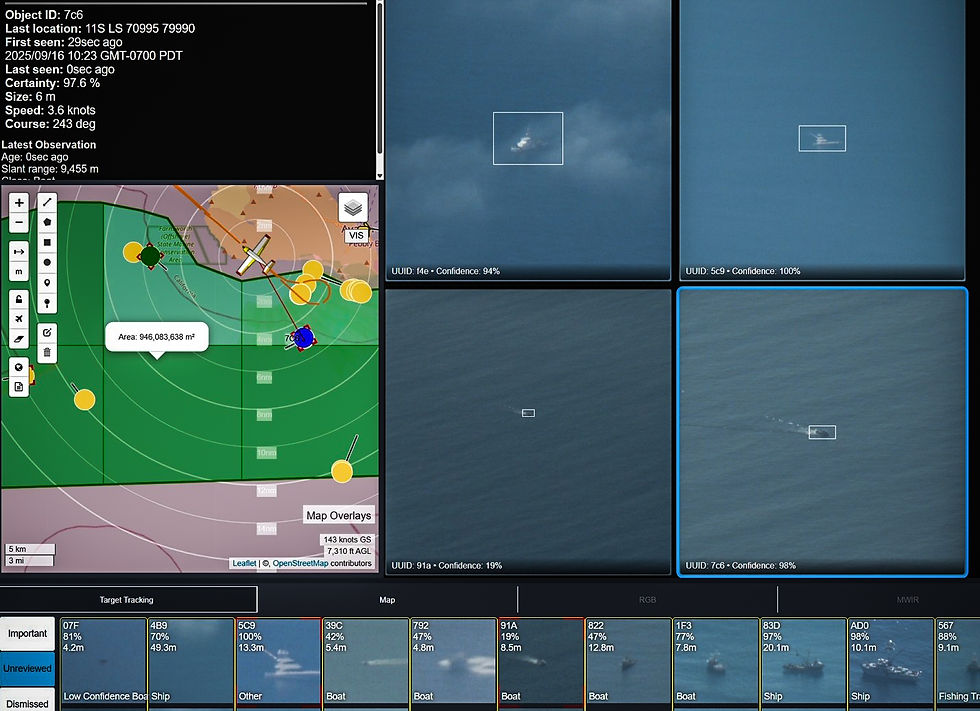
As unmanned and distributed surveillance platforms continue to expand collection capacity, the challenge of collecting, analyzing and exploiting large volumes of video data becomes more acute. ASO removes this bottleneck by enabling platforms to autonomously search, detect, prioritize, and report actionable information at the edge, supporting faster decisions and more effective use of ISR assets at scale.

A Scalable, READY NOW Solution
ASO is built on Overwatch Imaging’s existing commercial technology foundation, enabling a scalable approach to capability development across defense, civil, and environmental applications.
Because ASO originates from operationally deployed, commercially available systems, it represents a fundamentally different acquisition pathway. Rather than relying on long development cycles or purpose-built hardware programs, ASO can be integrated as a mission-ready software capability—accelerating deployment timelines and reducing risk.
This approach enables organizations to rapidly field proven sensor autonomy and begin generating value immediately. The underlying technology has already been exercised in real-world missions, providing a level of maturity and reliability that supports near-term operational use—not just future development.
About Overwatch Imaging:
Overwatch Imaging is an imagery intelligence technology company working to bring sensor autonomy to time-critical airborne search, detection, tracking and monitoring missions.
Our Automated Sensor Operator (ASO) software, native to our own line of purpose-built Smart Sensors and as an upgrade for airborne video gimbal platforms, brings Superhuman Vision and Workload Reduction to users of real-time imagery intelligence systems. We fundamentally believe that modern edge processing and AI-enabled autonomy can perform an important set of time-critical imagery intelligence missions better, faster and more safely than humans can alone.
Founded in 2016 in Hood River, Oregon, we support private sector companies as well as federal, state and local agencies around the world with missions ranging from wildfire mapping and disaster response to law enforcement, border security, maritime domain awareness and tactical intelligence


