AI-Enabled Sensor Autonomy for Modernizing Airborne ISR


Modern airborne intelligence, surveillance, and reconnaissance (ISR) operations generate more sensor data than human operators can reliably search, interpret, and act on in real time. Full-motion video (FMV) gimbals remain the backbone of tactical ISR across rotary-wing, fixed-wing, and unmanned platforms, but they are fundamentally manual instruments: an operator must steer the sensor, manage zoom and framing, and visually interpret the feed continuously to extract value. In high-tempo, high-consequence missions, this manual workload competes directly with the cognitive bandwidth operators need for tactical decision-making.
Overwatch Imaging's Automated Sensor Operator (ASO) resolves this tradeoff. ASO is a software-defined sensor autonomy platform that takes over the manually-intensive work of sensor operation — steering, zoom, wide-area search, object detection and tracking, and reporting — and delivers a stream of structured, geolocated, mission-relevant intelligence rather than raw video that must be watched and interpreted.
ASO is TRL 9, sensor-agnostic, and fielded today across maritime domain awareness, tactical ISR, wildfire response, border security, and infrastructure monitoring missions, integrated with EO/IR gimbals from Teledyne FLIR, L3Harris WESCAM, Trakka, and Trillium Engineering, with others in the pipeline.
This white paper describes ASO's technical architecture, core autonomy capabilities, human-machine teaming model, operational pedigree, and scalability pathways for defense and government ISR programs evaluating sensor autonomy as a force multiplier for existing and
future airborne platforms.

The Operational Challenge:
Manual Sensor Operation Doesn't Scale
Across maritime ISR, tactical operations, and wide-area search and mapping missions, the sensor operator is a common bottleneck. Conventional FMV gimbals powerful tools for streaming high-quality imagery, but search, detection, classification, and reporting still depend heavily human operators continuously engaging with the system and analyzing the output. In practice, this creates several persistent operational constraints:
Challenge | Manual Sensor Operation |
Data Overload | The volume of full-motion video and still imagery collected across a mission routinely exceeds what a single operator can review, let alone review well, especially over multi-hour patrols or wide search areas. |
Divided Attention & Fatigue | Continuous sensor slewing, zoom management and reframing compete for the attention operators need for track correlation, data cross-checking, tactical decision-making, and numerous mission duties unrelated to sensor control. Over time, this workload compounds fatigue and makes detection increasingly dependent on sustained human vigilance rather than sensor performance. |
Inconsistent Coverage | A gimbal's narrow IFOV means area coverage is only as good as the operator's search discipline. Small, slow-moving, or low-profile targets are easy to miss between glances. |
Slow Time-to-Intelligence | The manual workflow of observe, interpret, describe, and report adds latency between detection and decision, at exactly the moments when seconds matter. |
Poor Scalability | As missions add sensors, data sources, and platforms, the number of operators required to extract value from those feeds grows in proportion — an approach that does not scale at the pace or budget of modern ISR demands. |
These constraints are not unique to one platform or mission set. They are common across USCG maritime interdiction, DoD tactical ISR, wildfire air attack, and border security operations alike, and they underscore ASO’s force-multiplying value: Reducing operator workload while generating more actionable intelligence from every sensor, on every mission.

Introducing ASO: Software-Defined Sensor Autonomy
Automated Sensor Operator (ASO) is an AI-enabled, edge-based platform that automates many of the functions traditionally performed by a human sensor operator: controlling and steering the gimbal, executing search patterns, detecting and classifying objects of interest, and compiling the results into structured, shareable intelligence products.
ASO is not a passive post-processing tool layered on top of a video stream. It is a tightly coupled system that fuses real-time AI analytics with autonomous sensor control, dynamically steering the EO/IR gimbal itself based on mission parameters, onboard detection models, and, where available, cross-sensor cueing from AIS, GMTI, or other third-party data feeds. This closed loop between sensor control and real-time analysis at the edge is what allows ASO to deliver systematic, repeatable, wide-area coverage.
ASO Deployment | Description |
Autonomy upgrade for EO/IR Video Gimbals | ASO integrates with fielded EO/IR gimbals already installed on operational aircraft — including Teledyne FLIR, L3Harris WESCAM MX-Series, Trakka systems, and others — adding powerful autonomy capabilities through software, without changes to the airframe or sensor payload. |
Core software for all Overwatch Imaging Sensors | ASO is natively embedded in Overwatch Imaging's own purpose-built imaging payloads, delivering fully integrated, autonomous ISR capability out of the box for specialty applications and platforms that don't yet carry a gimbal. |

The ASO Sensing Cycle
ASO structures mission execution around the same Tasking, Collection, Processing, Exploitation, and Dissemination (TCPED) cycle that governs the broader ISR enterprise. ASO automates the three phases that traditionally consume the most operator time and attention. Tasking is handled upstream, when mission parameters, search geometry, and target priorities are defined; ASO then executes the rest of the cycle autonomously and delivers intelligence products form humans in the loop to review and act on.
Phase | Function |
Collection | Autonomously controls sensor movement and executes systematic scan patterns, optimizing zoom, resolution, and image overlap for target size, ground sample distance (GSD), and mission parameters. |
Processing and Exploitation | Processes imagery on the edge in real time using AI/ML detection and classification models, detecting and filtering objects by characteristics, fusing multi-signal data for additional layers of validation, and generating georeferenced maps and instant map products, all without requiring direct operator input |
Dissemination | Compiles detections, fused data layers, and map products into structured, geolocated intelligence outputs, and displays or transmits them immediately, reducing raw data to the information that actually matters. |
Manual Takeover | The operator can interrupt autonomous operation at any point in the cycle and assume direct manual control of the sensor instantly, preserving full operator authority regardless of what ASO is currently executing. |
Fig. 1 — The ASO sensing cycle automates Collection, Processing & Exploitation, and Dissemination — the phases of the TCPED cycle where operator workload and latency have traditionally been highest.
By running Collection, Processing/Exploitation, and Dissemination continuously, ASO sustains persistent, wide-area coverage for the duration of the mission, freeing the crew to focus on tactical command rather than the sensor.

Sensor and Standards Interoperability
ASO is designed to be sensor- and platform-agnostic. It has been integrated and demonstrated across multiple EO/IR gimbal product lines, including the Teledyne FLIR 380, L3Harris WESCAM MX-10, 15, 20, and 25, Trakka TC-300 systems, and Trillium Engineering gimbals, and supports rapid re-integration across product lines.
For cross-sensor and cross-platform cueing, ASO supports open data standards including NMEA 0183 (for AIS ingestion in maritime missions), STANAG 4609 (for full-motion video embedded metadata), and STANAG 4607 (for GMTI track ingestion), and can fuse EO/IR imagery with signals intelligence or other third-party metadata directly at the edge. This open-interface design is what allows ASO to plug into existing ISR architectures, including command-and-control and common operating picture systems, rather than requiring a proprietary ecosystem.
This architecture reflects a Modular Open Systems Approach (MOSA): ASO is built on open standards and modular interfaces by design, giving program offices a non-proprietary path to integrate new sensors, payloads, and mission systems over time without vendor lock-in.
System Architecture
ASO runs on a low-SWaP (Size, Weight, and Power) edge compute module built on the NVIDIA Orin AGX System on Module, purpose-selected for the throughput needed to run AI detection models in real time at the edge.
The processor accepts standard gimbal video and control interfaces (HD-SDI with KLV metadata and Ethernet), so it can be added externally to an existing FMV system without modifying airframe or the sensor itself. Data flows from the OEM gimbal into the ASO processor, where AI inference and sensor-control logic run locally at the edge, and results are delivered to the operator workstation (laptop, tablet, or existing mission management system) over standard Ethernet.
Technology Readiness and Operational Fielding
Overwatch Imaging characterizes ASO's baseline product as TRL 9, and the evidence base supports a mature commercial core: operational deployment on crewed and uncrewed aircraft, commercial availability, integration with established EO/IR systems, OEM collaboration, and ongoing U.S. government work.
Founded in 2016 in Hood River, Oregon, Overwatch Imaging has spent the past decade developing and fielding automated imaging systems for defense, homeland security, civil government, and commercial operators. This broad operational experience establishes ASO as a proven, trusted capability with a track record across the mission sets most relevant to tactical airborne ISR operators.

Core Capabilities
The central design principle behind ASO is that new sensor capability must reduce operator workload, not add to it. Every auxiliary system introduced into a cockpit or mission console competes for the same finite attention as tactical command, navigation, and communication, and a sensor that requires continuous manual engagement to extract value ultimately competes with the mission it's meant to support.
ASO changes the operator's role from sensor manipulator to intelligence consumer and decision-maker. Instead of steering a camera, watching a feed, and relaying what they see, the operator receives structured detections. ASO's value is measured not only in what it detects, but in the attention it gives back to the human in the loop.
Category | Capability | What It Does |
Sensing & Collection | Automated Sensor Steering | Actively commands gimbal zoom, pointing, and scan pattern to optimize coverage, resolution, and overlap — rather than relying on manual framing. |
Real-Time Mapping | Systematic image collection paired with onboard edge processing generates instantaneous, georeferenced map products during the mission itself. | |
Onboard Intelligence | Real-Time Edge Processing | Detection, classification, and reporting run onboard at the sensor — no dependency on a datalink or ground-based processing, even in contested or bandwidth-constrained environments. |
AI-Driven Detection & Classification | Edge-based AI/ML models identify mission-critical objects — from go-fast boats to ground vehicles, personnel, and thermal anomalies — with additional detector classes for customer-specific missions. | |
Multi-Int Sensor Fusion | ASO fuses EO/IR imagery with signals intelligence and other metadata onboard, using probabilistic association logic and real-time filtering to maintain accurate tracks across complex operating environments. Open interfaces support data feeds such as AIS and GMTI. | |
Operational Flexibility | Remote & Pre-Programmable Operation | Operable onboard, remotely via datalink, or fully pre-programmed to run autonomously with no datalink or direct human engagement required. |
Manual/Automated Mode Toggle | Instant transition between ASO operation and traditional manual gimbal control, preserving full operator authority. | |
Sensor-Agnostic, Multi-Platform Integration | A scalable software platform that integrates across gimbal product lines and airframes — rotary-wing, fixed-wing, and UAS. | |
Sustainment & Usability | Upgradeable Architecture | Detection models and software update independently of the hardware, protecting the value of a deployed system as target classes and mission profiles evolve. |
Intuitive Interface | Interactive, browser-based UI requiring minimal training, integrating with existing mission systems, laptops, or tablets rather than a proprietary control station. |

Operational Performance
Across fielded deployments, ASO has consistently demonstrated substantial gains over manually operated, non-ASO-equipped EO/IR gimbal systems on the same class of sensor:
Metric | Improvement over manual FMV |
Detection speed | 4 – 10X faster |
Effective area coverage | 2 – 20X greater |
Operator workload / cognitive burden | Substantially reduced through automation of search, framing, and monitoring tasks |
Integration time (sensor swap, demonstrated) | Under 1 hour between WESCAM MX-15 and MX-10 systems |
These gains result directly from pairing autonomous sensor control with continuous edge-based analysis, allowing coverage and detection speed to scale with ASO’s ability to search systematically and detect consistently throughout the mission—not with an operator’s capacity to sustain attention.

Deployability and Integration
ASO is built to minimize the risk, cost, and schedule impact of adopting sensor autonomy. Because it operates as a compute module added externally to existing FMV gimbals, integration requires no modification to the aircraft beyond processor mounting, no new sensor procurement, and no extended aircraft downtime for modifications
.
Rapid integration: Fielded demonstrations have shown ASO integrated and operational in under an hour. Program-level fielding, from planning through initial operational capability on an existing platform, can been achieved in as little a few weeks, depending on scope. ASO connects to existing gimbal video and control interfaces (HD-SDI, Ethernet, KLV metadata) and existing aircraft power.
No enabling technology dependencies: ASO requires no new sensor payload, datalink, or ground infrastructure to operate. It processes and reports at the edge, on the aircraft, using the sensor already installed.
Alignment with modernization programs: ASO is designed to ride alongside existing gimbal modernization and fleet upgrade programs, adding autonomy to systems already being installed rather than competing with them for schedule or budget.
Field training and usability: The browser-based operator interface is designed for rapid field training and fits within existing EO/IR gimbal operating procedures, minimizing the burden of transition for operational units.
The result is a modernization pathway that most programs can pursue as a software and compute addition to what they already operate and already plan to sustain, rather than as a new acquisition program in its own right.

Scalability Across Missions and Platforms
Because ASO's autonomy is implemented in software and its sensor interfaces are open, the same platform scales across airframes, sensors, and mission types without re-architecting the core system:
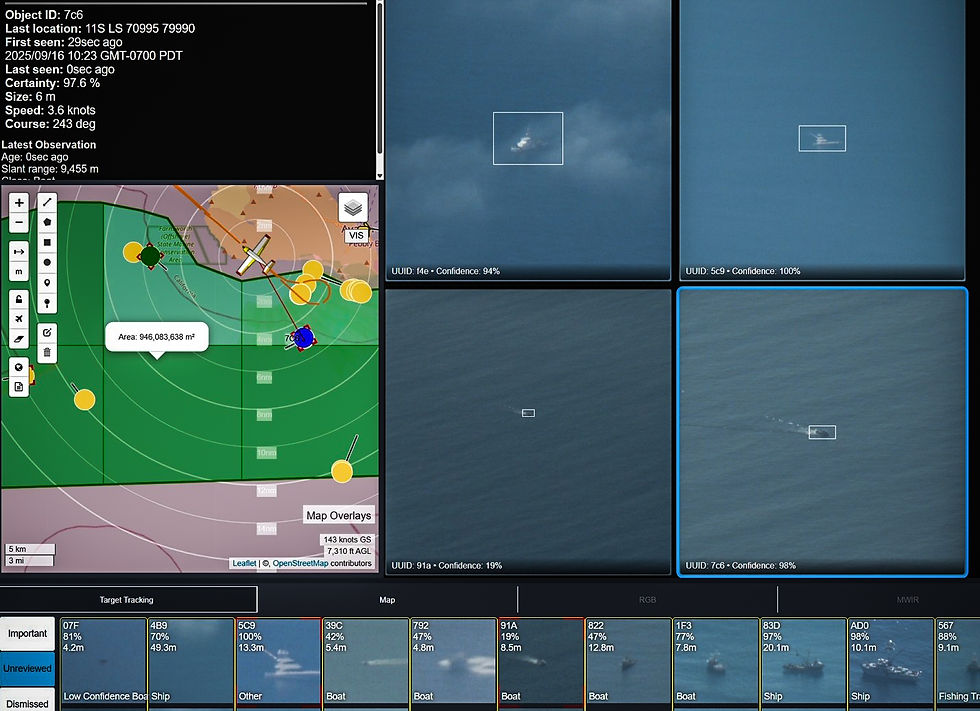
Maritime search and interdiction: Detects and tracks vessels, including dark targets, go-fast boats, and low-profile vessels, across large ocean areas, supporting maritime domain awareness and interdiction missions.
Tactical and strategic ISR: Provides real-time threat detection, classification, and geolocated reporting for reconnaissance and targeting missions.
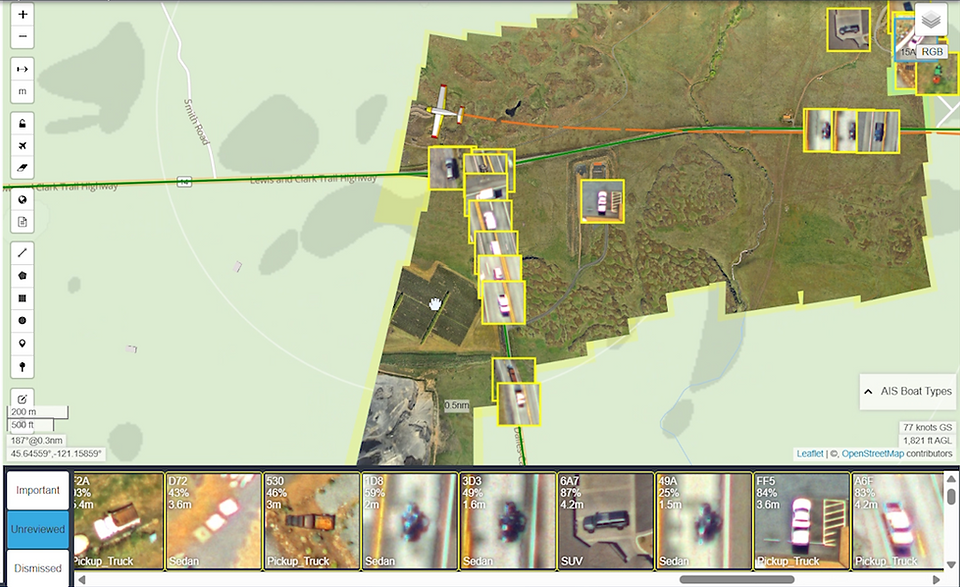
Land-based operations: Detects vehicles, personnel, and activity across varied terrain for border security, infrastructure protection, and law enforcement missions.
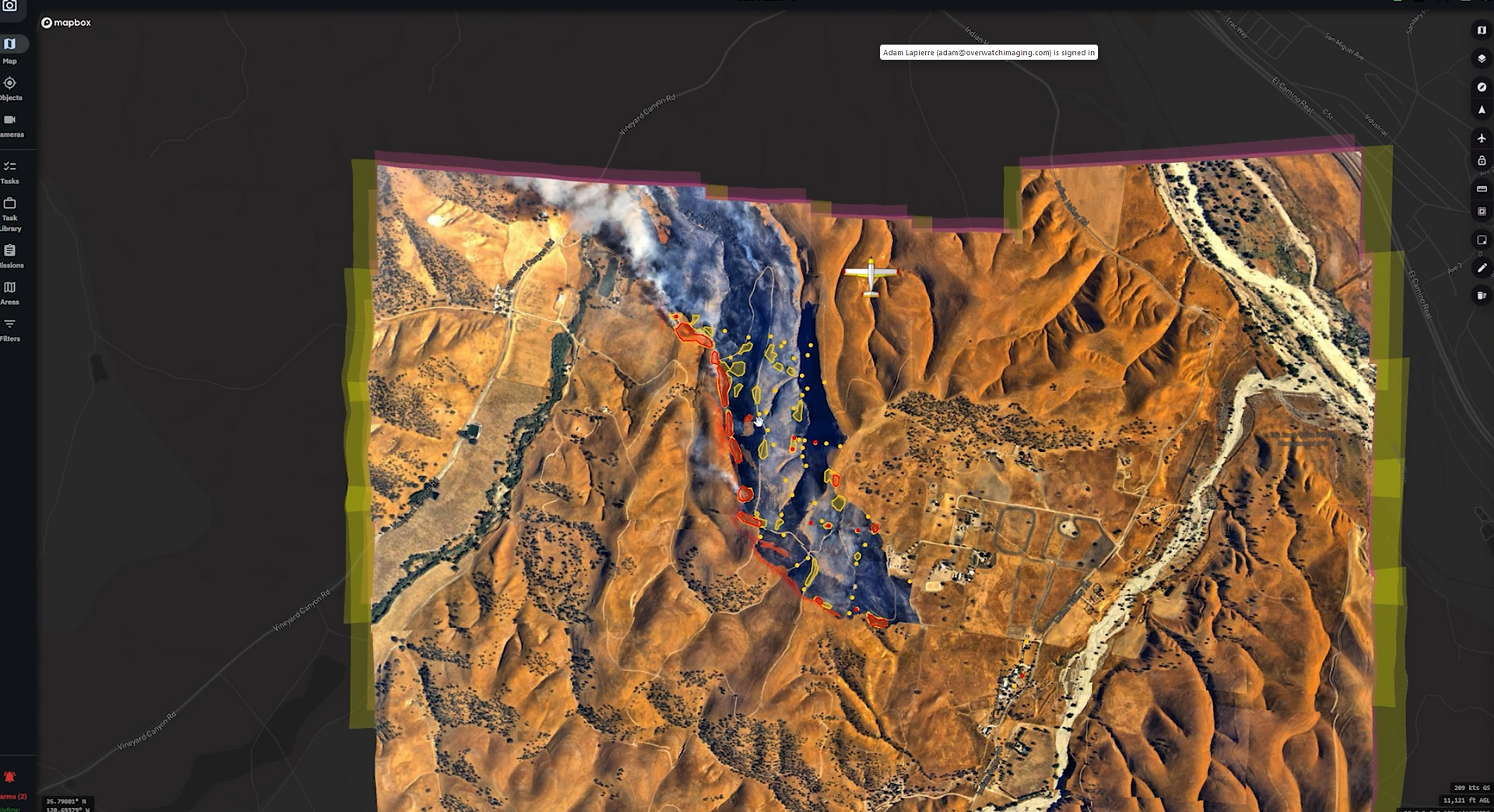
Wildfire and disaster response: Executes systematic scan patterns over active incidents, automatically detecting and mapping incident areas, hotspots and firelines in real time.
Infrastructure monitoring: Supports continuous, automated surveillance of linear infrastructure and protected sites, flagging anomalies and intrusions without constant human monitoring.
This same modularity extends to platforms: ASO operates today on manned rotary-wing and fixed-wing aircraft and on unmanned aircraft ranging from long-endurance maritime patrol UAS to smaller tactical platforms, with the compute footprint and power draw sized to fit within existing payload constraints across that range.




Mission Pattern | ASO Contribution | Defense-User Benefit |
Wide-area maritime ISR | Systematic vessel search, small/low-profile contact detection, AIS comparison, target interrogation | Earlier contact establishment, broader coverage, selective reporting in constrained links |
Tactical overland ISR | Vehicle/person detection and track, points of interest, external cueing | Faster target acquisition, repeatable surveillance, reduced crew workload |
Border and coastal surveillance | Persistent route/area search, anomaly cueing, geolocated detections | Consistent coverage with limited crews, rapid cueing of response assets |
Distributed uncrewed ISR | Preplanned no-touch missions, onboard exploitation, low-bandwidth products | Scales collection without scaling remote video monitoring |
Multipoint overwatch | Autonomous slew/revisit among several tracks while preserving broader search | One sensor against multiple observation obligations; shorter decision cycles, enhanced situational awareness |
Rapid mapping / change awareness | Automated multispectral collection, mosaics, georeferenced products | Operational picture generated during the mission itself |
Table 6. Representative defense mission applications. Target classes and available functions are configuration-dependent.
The common thread across these missions is not automation of a single task, but compression of the sensor-to-decision loop: collect the right data, exploit it where it is generated, deliver the operator a prioritized result, and retask the sensor or another asset immediately. This is most valuable where crew size, endurance, data links, or simultaneous mission demands constrain conventional FMV operations.
Conclusion
Airborne ISR is limited not by what the sensor can see, but by how much information a human operator can collect, analyze, interpret, and act on in real time. Overwatch Imaging’s Automated Sensor Operator directly addresses this constraint. ASO is a TRL 9, sensor-agnostic, edge-processed autonomy platform that automates search, detection, and reporting while returning cognitive bandwidth to the operator rather than consuming more of it.
With a fielded track record across maritime, tactical, wildfire, and border security missions; demonstrated rapid integration across major EO/IR gimbal product lines; and a software-defined architecture built to scale across platforms and mission sets, ASO offers defense and government ISR programs a low-risk, high-impact pathway to modernize existing sensor fleets with autonomy today. ASO is not a future capability years away - it is a proven capability ready to make an impact now.