The Many Contours of Geospatial Innovation

Matt Nugent, VP of Product Management at Overwatch Imaging, was featured on Episode 277 of The Geoholics Podcast, a popular show dedicated to professionals in the surveying, geomatics, and geospatial industries.
In a wide-ranging conversation, Nugent talked about his passion for GIS, how Overwatch Imaging autonomously collects and transforms raw data into intelligence, and the customer-led approach he has instilled across all of Overwatch Imaging’s products.
Check out highlights from the conversation below:
From Music to Maps
Many geospatial careers chart an unexpected path.
Nugent studied music and economics in college. Today, he’s so passionate about GIS that he has maps on his bedroom wall. So, the hosts asked, what happened in between?
The turning point was a project at Portland General Electric. Instead of boxes and forms, the project featured maps, where users could zoom in and explore imagery across multiple dimensions. As a visually-oriented person, a lightbulb went off. He pushed to work on the GIS project, and has been working in the field ever since.
Today, Nugent leads a team working to transform how teams collect, analyze, package, and disseminate geospatial intelligence using cutting-edge AI and autonomy.
It’s not where you start, it’s how you embrace opportunity along the way.
The Eyes, The Brain, and The Neck
For some, applying AI to geospatial intelligence means automating analysis. An AI tool will take an existing image, scan it, and identify an object.
But that leaves much of the work in the hands of the sensor operator. Steering, slewing, zooming, and directing the sensor are some of the most time-consuming tasks required to produce a result.
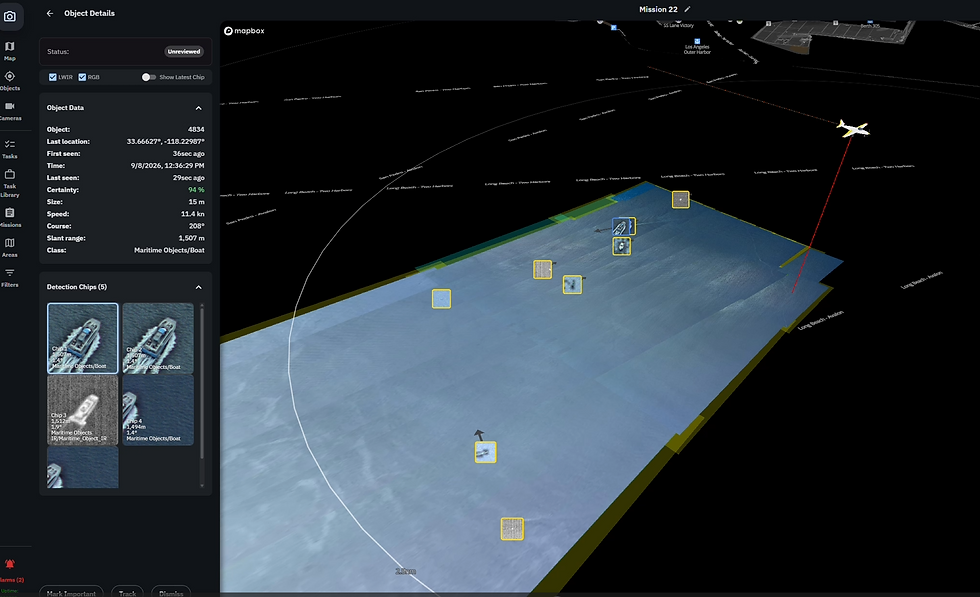
True sensor autonomy, as provided by Overwatch Imaging, delivers automation across the entire ISR workflow. As Nugent describes it, Overwatch Imaging’s ASO software acts as the eyes, the neck, and the brain of the sensor. Tedious sensor operations tasks are performed by AI-enabled software, and human operators can take that time and focus on other, higher-value tasks.
“We’re taking the least favorite things that an operator has to do, and doing those things for them. Usually, with the time they get back, they get to do the things they actually like to do.”
Real-Time Intelligence
Once imagery is collected, analysis and packaging is required to derive value. Raw data becomes analytics. Analytics become data products.
In the past, this process took hours and only happened after data was sent back to the ground.
When autonomy is layered on, those data products are delivered in real time. What’s sent over a data link before the plane lands is ready to deliver value by the time it gets to the ground. Through ASO’s unique combination of AI and edge processing, data is delivered to responders and service members in the seconds and minutes that make a difference for the mission.
Data products become intelligence. Intelligence impacts decision making for the mission.
Customer-Led
Start with the problem, not the product. At the end of the day, technology is built to serve people and deliver value. You have to start from the challenge those people are facing and work backward.
Leading product at Overwatch Imaging, Nugent directs an agile approach that is built around talking to customers, deploying rapidly, gathering feedback, and making improvements. Sometimes, that can take a few cycles to get right, to build a product that an operator actually wants to use, not a solution that they didn’t ask for.
Show, Not Tell
Around the Overwatch Imaging office and out on flights, you’ll hear a common phrase:
“Show, not tell.”
It’s easy to toss out an idea, or an opinion. It’s another thing to draw it on a whiteboard, build a mockup, or spin up a wireframe to work through the solution together.
It’s another thing altogether to take it up in the air and see how it performs on the plane. That’s what Overwatch Imaging does. That’s where technology meets the real world.
“It’s awesome to work at a startup,” Nugent said. “You get to see the impact of the things you're working on, week-to-week, in real time.”