Cutting-Edge Autonomy for Real-World Impact

Overwatch Imaging Founder and CEO, Greg Davis, was featured as a guest on Techlandia, a podcast that spotlights leaders in Oregon’s technology ecosystem.
In the interview, hosted by Technology Association of Oregon President Skip Newberry, Davis discussed his career journey as an aerospace innovator, the growth of the Columbia River Gorge technology community, and the evolution of Overwatch Imaging from a bootstrapped startup to a global provider of mission-ready sensor autonomy.
Here are three takeaways from the conversation:

The Gorge Tech Ecosystem: Community and Cutting-Edge
In the 1990s, Tad McGeer moved from Silicon Valley to the Columbia River Gorge, and pioneered unmanned aerial vehicles (UAVs) with his company, Insitu. That catalyzing moment led the Gorge to take flight as an aerospace and defense hub. Insitu was later acquired by Boeing. Other innovative companies followed, including Cloud Cap, which is now a part of RTX (formerly Raytheon). Today, aerospace technology is a massive contributor to the local economy. Companies like Overwatch Imaging serve a global market, while attracting new residents to the Gorge with a distinctive blend of community and cutting-edge.
“I think this is just such an incredible place to live and work,” said Davis, who moved to the Gorge to work at Insitu in 2006. “I love the small town feel and the community that I get to raise my children in, but at the same time I get to participate in some really cutting-edge work in the aerospace and defense industry. I think that combination is really special.”
AI and Autonomy for Missions That Matter
When Overwatch Imaging was founded in 2016, aerospace innovation was at an inflection point. Airborne autonomous capabilities were beginning to demonstrate applicability to a number of important markets, while cutting-edge technologies in artificial intelligence, image processing, and computer vision were racing ahead.
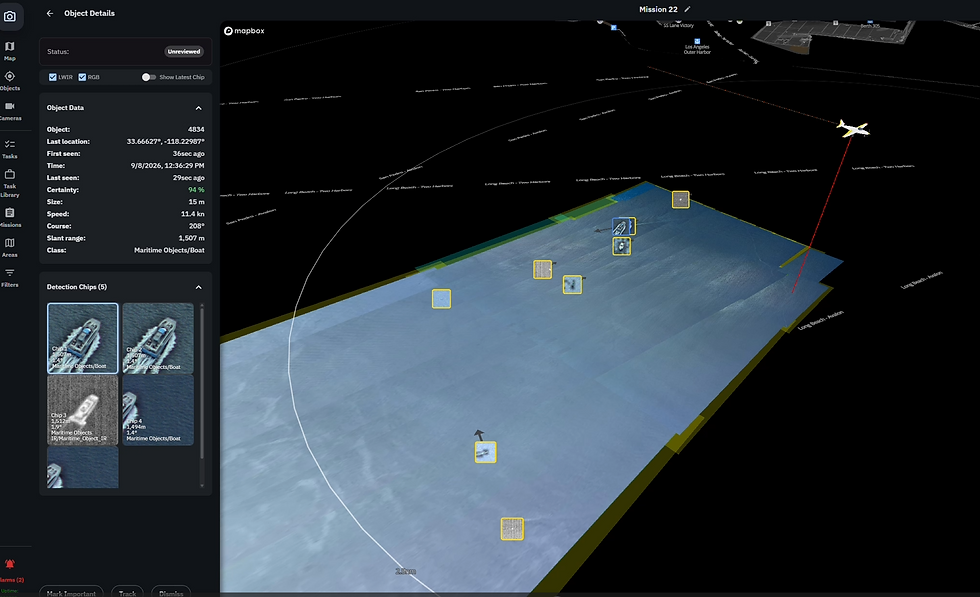
“I saw these technologies around edge processing and AI opening up the capability to find small things quickly, and do that automatically,” Davis said. “We saw how that could make a big impact in these markets by bringing what we now describe as superhuman vision, along with workload reduction, to the users of overhead intelligence systems.”
Overwatch Imaging was born out of this convergence to apply groundbreaking autonomous object detection capabilities to missions that matter. Some of the company’s first missions were informed by the environment in the Pacific Northwest, from wildfire intelligence in the forest to maritime search and rescue and maritime domain awareness on the water. Over the years, Overwatch Imaging has expanded to provide sensor autonomy to a wide variety of missions, including emergency response, defense, civil, border security, and commercial missions. But the commitment to serving the mission has remained the same.
What’s Next in Airborne Intelligence?
Davis is a true believer in the power of AI and autonomy to make an impact on real-world missions. That passion has guided the company for a decade, even as the market, technology, and team have grown and changed. When Newberry asked where he sees the company’s work going next, Davis stressed the importance of continuous evolution.
“As we evolve from presenting timely intelligence to decision makers, where we are working today, to presenting predictive analytics to decision makers,” Davis said, “I think that's a really exciting next step that will make things like wildfire response just orders of magnitude more efficient and effective, which then leads to better scalability of those response actions. So I’m really excited to see the increasing sophistication of real time AI at the edge, driving to better decisionmaking capability for the people that are doing those time-critical missions that matter.”